Sendirian di kamar, mlongo nunggu mesin cuci di lantai 3 berhenti berputar *berputar secara harfiah, karena mesin cucinya goyang heboh sana-sini*. Nica, temen sekamarku yang hobi mudik *berhubung rumahnya di Kudus, deket dari sini* belum juga sampai kost. Di tengah ke-mlongoanku, aku merasa kalo sekarang kamarku jadi so sweet. Aku duduk di kasur, serasa lagi naik perahu di tengah danau, dengan guling sebagai dayungku. Di sebelah kanan terlihat matahari terbenam yang berwarna orange. Di sebelah kiri, kulihat siluet senja dengan warna orange khasnya, pepohonan melambai-lambai tertiup angin. Semilir angin senja menerpa wajahku.
Kalau kalian percaya, berarti kalian sama begonya denganku. Lagi asyik-asyik berfantasi *duile*, tiba-tiba si Upil membuka pintu kamarku. Dia terkejut, akupun terkejut. Guling terkejut, cicak terkejut. Semuanya terkejut!
Upil: “Ngapa koh? Cengar-cengir dhewek!” (artinya: Ngapain lo? Senyam-senyum sendiri!)
Aku: (nyengir)
Upil: “Dening kamarmu siki peteng retung yak? Loh, opo kui, cahaya warna oren?” (Kok sekarang kamar lo gelap banget sih? Lho, apaan tuh, cahaya warna orange?)
Untuk membuat percakapan tersebut terlihat asyik, akupun menjawabnya dengan bahasa Banyumas.
Aku: “Kuwee, Kost Sri Hardi pasang tandon banyu anyar. Nesss, pasange pas nang njaba glasboke inyong! Mulane kamare dadi oren! Tandone kenang srengenge mangklih kaya kuwee.”(tuh Kost Sri Hardi pasang tandon air baru. Shit, masangnya pas di Luar glassbox gue! Makanya nih kamar jadi orange! Tandonnya terkena paparan sinar matahari, jadinya begini!)
Upil: “njur ngapa koh kowe merem-merem karo cengar-cengir? Nguwel-nguwel guling napa!” (terus ngapa lo merem-merem sambil nyengir? Ngucel-ucel guling segala!)
Aku: (nyengir) “Lah, critane bhaen nyong lagi nang danau di senja hari, hehehe." (Yah, ceritanya gue lagi di danau di senja hari. Hehehe.)
Upil: “Cah gemblung! Ngeneh bukune inyong, aja di jagongi!” (Gila lu! Sini buku gue jangan lo dudukin!)
Begitulah kisah aslinya. Sumpah aku dongkol banget waktu pulang latihan drama, kamarku yang semula berwarna hijau berubah menjadi orange kesilau-silauan kayak jeruk mandarin yang udah mateng. Tambahan bunyi orang ngebor beton pun terdengar. Aku teriak-teriak sambil memukul-mukul tembok ala bintang FTV lagi frustasi. Kemungkinan tuh bapak ngebor sisi luar tembok itu.
“Pak, tandonnya jangan taroh di situ paaaaaak!”
Yang bikin tambah stress, aku baru inget kalo temboknya tebel banget, dan nggak ada jendela di sisi tembok tersebut. Otomatis bapak pengebornya ndenger, kecuali kalo dia Superman.
Selasa, 18 Oktober 2011

Kamis, 28 Juli 2011
Comparison between Indonesian traditional music instrument (Gamelan) and Japanese traditional music instrument (Gagaku)
History of gamelan music
The gamelan predates the Hindu-Buddhist culture that dominated Indonesia in its earliest records and instead represents a native art form. The instruments developed into their current form during the Majapahit Empire. In contrast to the heavy Indian influence in other art forms, the only obvious Indian influence in gamelan music is in the Javanese style of singing.
In Javanese mythology, the gamelan was created by Sang Hyang Guru in Saka era 167 (c. AD 230), the god who ruled as king of all Java from a palace on the Maendra mountains in Medangkamulan (now Mount Lawu). He needed a signal to summon the gods and thus invented the gong. For more complex messages, he invented two other Gongs, thus forming the original gamelan set.
The earliest image of a musical ensemble is found on the 8th century Borobudur temple, Central Java. Musical instruments such as the bamboo flute, bells, drums in various sizes, lute, and bowed and plucked string instruments were identified in this image. However it lacks metallophones and xylophones. Nevertheless, the image of this musical ensemble is suggested to be the ancient form of the gamelan.
In the palaces of Java are the oldest known ensembles, the Munggang and Kodokngorek gamelans, apparently from the 12th century. These formed the basis of a "loud style". A different, "soft style" developed out of the kemanak tradition and is related to the traditions of singing Javanese poetry, in a manner which is often believed to be similar to performance of modern bedhaya dance. In the 17th century, these loud and soft styles mixed, and to a large extent the variety of modern gamelan styles of Bali, Java, and Sunda resulted from different ways of mixing these elements. Thus, despite the seeming diversity of styles, many of the same theoretical concepts, instruments, and techniques are shared between the styles.
History of gagaku
By the 7th century, the gakuso (a zither) and the gakubiwa (a short-necked lute) had been introduced in Japan from China. Various instruments including these two were the earliest used to play gagaku.
Gagaku, the oldest classical music in Japan, was introduced into Japan with Buddhism from the Korean Peninsula. In 589, Japanese official diplomatic delegations were sent to China (during the Sui dynasty) to learn Chinese culture.
Komagaku and togaku arrived in Japan during the Nara period (710-794), and settled into the basic modern divisions during the Heian period (794-1185). Gagaku performances were played by musicians who belonged to hereditary guilds. During the Kamakura period (1185-1333), military rule was imposed and gagaku was performed in the homes of the aristocracy, but rarely at court. At this time, there were three guilds based in Osaka, Nara and Kyoto.
Because of the Ōnin War, a civil war from 1467 to 1477 during the Muromachi period, gagaku in ensemble had been stopped playing in Kyoto for about 100 years. In the Edo era, Tokugawa government re-organized the court style ensemble, which is the direct roots of the present one.
After the Meiji Restoration of 1868, musicians from all three guilds came to the capital and their descendants make up most of the current Tokyo Imperial Palace Music Department. By that time, the present ensemble composition had been established, which consists of three wind instruments – hichiriki, ryūteki, and shō (bamboo mouth organ used to provide harmony) – and three percussion instruments – kakko (small drum), shoko (metal percussion), and taiko (drum) or dadaiko (large drum), supplemented by gakubiwa.
Gagaku also accompanies classical dance performances (called bugaku 舞楽), and both are used in religious ceremonies by the Tenrikyo movement and a few Buddhist temples.
Gagaku is related to theater, which developed in parallel. Noh was developed in the 14th century.
Today, gagaku is performed in two ways:
• as kangen, concert music for winds, strings and percussion,
• as bugaku, or dance music for which the stringed instruments are omitted.
Komagaku survives only as bugaku.
Contemporary gagaku ensembles, such as Reigakusha (伶楽舎), perform contemporary compositions for gagaku instruments. This sub-genre of contemporary works for gagaku instruments, which began in the 1960s, is called reigaku (伶楽). 20th century composers such as Tōru Takemitsu have composed works for gagaku ensemble, as well as individual gagaku instruments.
THE INSTRUMENTS OF GAMELAN
• metallophones
• xylophones
• drums
• gongs
• bamboo flutes
• bowed and plucked strings,
• and also vocalists.
THE INSTRUMENT OF GAGAKU
Wind, string and percussion instruments are essential elements of gagaku music.
Wind
- Hichiriki (篳篥), oboe
- O-hichiriki (大篳篥)
- Ryūteki (龍笛), transverse flute
- Shō (笙), mouth organ
- U (竽), large mouth organ
- Komabue (高麗笛)
- Azuma-asobi-bue (東遊笛, also called chukan
- Kagurabue (神楽笛)
- Shakuhachi (尺八)
- Haishō (排簫)
String
* Gakubiwa (楽琵琶), 4-stringed lute
* Gakuso (koto, 箏), 13-string zither of Chinese origin
* Kugo, (箜篌)angled harp used in ancient times and recently revived
* Genkan (阮咸)
* Yamatogoto (大和琴, also called wagon), zither of Japanese origin, with 6 or 7
strings
Percussion
- Shōko (鉦鼓), small gong, struck with two horn beaters
- Kakko (鞨鼓), small hourglass-shaped drum struck with two wooden sticks
- Tsuri-daiko (釣太鼓), drum on a stand with ornately painted head, played with a
padded stick
- Ikko, small, ornately decorated hourglass-shaped drum
- San-no-tsuzumi (三の鼓), hourglass-shaped drum
- Shakubyoshi (笏拍子, also called shaku), clapper made from a pair of flat wooden
sticks
- Hōkyō (方響)
Influence on Western music
The gamelan has been appreciated by several western composers of classical music, most famously Claude Debussy who heard a Javanese gamelan play at the Paris Exposition of 1889 (World's Fair). (The gamelan Debussy heard was in the slendro scale and was played by Central Javanese musicians.) Despite his enthusiasm, direct citations of gamelan scales, melodies, rhythms, or ensemble textures have not been located in any of Debussy's own compositions. However, the equal-tempered whole tone scale appears in his music of this time and afterward, and a Javanese gamelan-like heterophonic texture is emulated on occasion, particularly in "Pagodes", from Estampes (solo piano, 1903), in which the great gong's cyclic punctuation is symbolized by a prominent perfect fifth.
The composer Erik Satie, an influential contemporary of Debussy, also heard the Javanese gamelan play at the Paris Exposition of 1889. The repetitively hypnotic effects of the gamelan were incorporated into Satie's exotic Gnossienne set for piano.
Direct homages to gamelan music are to be found in works for western instruments by John Cage, particularly his prepared piano pieces, Colin McPhee, Lou Harrison, Béla Bartók, Francis Poulenc,Olivier Messiaen, Pierre Boulez, Bronislaw Kaper and Benjamin Britten. In more recent times, American composers such as Henry Brant, Steve Reich, Philip Glass, Dennis Murphy, Loren Nerell,Michael Tenzer, Evan Ziporyn, Daniel James Wolf and Jody Diamond as well as Australian composers such as Peter Sculthorpe, Andrew Schultz and Ross Edwards have written several works with parts for gamelan instruments or full gamelan ensembles. I Nyoman Windha is among contemporary Indonesian composers that have written compositions using western instruments along with Gamelan. Hungarian composer György Ligeti wrote a piano étude called Galamb Borong influenced by gamelan. American folk guitarist John Fahey included elements of gamelan in many of his late-60s sound collages, and again in his 1997 collaboration with Cul de Sac, The Epiphany of Glenn Jones. The experimental art-rock band King Crimson, while not using gamelan instruments, used interlocking rhythmic paired guitars that were influenced by gamelan. On the debut EP of Sonic Youth the track 'She's not Alone' has a gamelan timbre. Experimental pop groups The Residents, 23 Skidoo (whose 1984 album was even titled Urban Gamelan), Mouse on Mars, His Name Is Alive, Xiu Xiu, Macha, Saudade, The Raincoats and the Sun City Girls have used gamelan percussion. The gamelan has also been used by British multi-instrumentalist Mike Oldfield at least three times, "Woodhenge" (1979), "The Wind Chimes (Part II)" (1987) and "Nightshade" (2005). Avant-garde performance band Melted Men uses Balinese gamelan instruments as well as gamelan-influenced costumes and dance in their shows. The Moodswinger built by Yuri Landman gives gamelan–like clock and bell sounds, because of its 3rd bridge construction. Indonesian-Dutch composer Sinta Wullur has integrated Western music and gamelan for opera.
Recently, many Americans were first introduced to the sounds of gamelan by the popular anime film Akira. Gamelan elements are used in this film to punctuate several exciting fight scenes, as well as to symbolize the emerging psychic powers of the tragic hero, Tetsuo. The gamelan in the film's score was performed by the members of the Japanese musical collective Geinoh Yamashirogumi, using their semar pegulingan and jegog ensembles. Gamelan and kecak are also used in the soundtrack to the video games Secret of Mana and Sonic Unleashed. The musical soundtrack for the Sci Fi Channel series Battlestar Galactica features extensive use of the gamelan, particularly in the 3rd season, as do Alexandre Desplat's scores for Girl With A Pearl Earring and The Golden Compass.
Loops of gamelan music appear in electronic music. An early example is the Texas band Drain's album Offspeed and In There, which contains two tracks where trip-hop beats are matched with gamelan loops from Java and Bali and recent popular examples include the Sofa Surfers' piece Gamelan, or EXEC_PURGER/.#AURICA extracting, a song sung by Haruka Shimotsuki as part of the Ar tonelico: Melody of Elemia soundtracks.
Influence on Western music (GAGAKU)
Beginning in the 20th century, several western classical composers became interested in gagaku, and composed works based on gagaku. Most notable among these are Henry Cowell (Ongaku, 1957),La Monte Young (numerous works of drone music, but especially Trio for Strings, 1958), Alan Hovhaness (numerous works), Olivier Messiaen (Sept haïkaï, 1962), Lou Harrison (Pacifika Rondo, 1963), Benjamin Britten (Curlew River, 1964), and Bengt Hambraeus (Shogaku, from Tre Pezzi per Organo, 1967).
One of the most important gagaku musicians of the 20th century, Masataro Togi (who served for many years as chief court musician), instructed American composers such as Alan Hovhaness andRichard Teitelbaum in the playing of gagaku instruments.
By :
Dyah Mustikareni
Dimas Wahyu R
Source:
wikipedia
The gamelan predates the Hindu-Buddhist culture that dominated Indonesia in its earliest records and instead represents a native art form. The instruments developed into their current form during the Majapahit Empire. In contrast to the heavy Indian influence in other art forms, the only obvious Indian influence in gamelan music is in the Javanese style of singing.
In Javanese mythology, the gamelan was created by Sang Hyang Guru in Saka era 167 (c. AD 230), the god who ruled as king of all Java from a palace on the Maendra mountains in Medangkamulan (now Mount Lawu). He needed a signal to summon the gods and thus invented the gong. For more complex messages, he invented two other Gongs, thus forming the original gamelan set.
The earliest image of a musical ensemble is found on the 8th century Borobudur temple, Central Java. Musical instruments such as the bamboo flute, bells, drums in various sizes, lute, and bowed and plucked string instruments were identified in this image. However it lacks metallophones and xylophones. Nevertheless, the image of this musical ensemble is suggested to be the ancient form of the gamelan.
In the palaces of Java are the oldest known ensembles, the Munggang and Kodokngorek gamelans, apparently from the 12th century. These formed the basis of a "loud style". A different, "soft style" developed out of the kemanak tradition and is related to the traditions of singing Javanese poetry, in a manner which is often believed to be similar to performance of modern bedhaya dance. In the 17th century, these loud and soft styles mixed, and to a large extent the variety of modern gamelan styles of Bali, Java, and Sunda resulted from different ways of mixing these elements. Thus, despite the seeming diversity of styles, many of the same theoretical concepts, instruments, and techniques are shared between the styles.
History of gagaku
By the 7th century, the gakuso (a zither) and the gakubiwa (a short-necked lute) had been introduced in Japan from China. Various instruments including these two were the earliest used to play gagaku.
Gagaku, the oldest classical music in Japan, was introduced into Japan with Buddhism from the Korean Peninsula. In 589, Japanese official diplomatic delegations were sent to China (during the Sui dynasty) to learn Chinese culture.
Komagaku and togaku arrived in Japan during the Nara period (710-794), and settled into the basic modern divisions during the Heian period (794-1185). Gagaku performances were played by musicians who belonged to hereditary guilds. During the Kamakura period (1185-1333), military rule was imposed and gagaku was performed in the homes of the aristocracy, but rarely at court. At this time, there were three guilds based in Osaka, Nara and Kyoto.
Because of the Ōnin War, a civil war from 1467 to 1477 during the Muromachi period, gagaku in ensemble had been stopped playing in Kyoto for about 100 years. In the Edo era, Tokugawa government re-organized the court style ensemble, which is the direct roots of the present one.
After the Meiji Restoration of 1868, musicians from all three guilds came to the capital and their descendants make up most of the current Tokyo Imperial Palace Music Department. By that time, the present ensemble composition had been established, which consists of three wind instruments – hichiriki, ryūteki, and shō (bamboo mouth organ used to provide harmony) – and three percussion instruments – kakko (small drum), shoko (metal percussion), and taiko (drum) or dadaiko (large drum), supplemented by gakubiwa.
Gagaku also accompanies classical dance performances (called bugaku 舞楽), and both are used in religious ceremonies by the Tenrikyo movement and a few Buddhist temples.
Gagaku is related to theater, which developed in parallel. Noh was developed in the 14th century.
Today, gagaku is performed in two ways:
• as kangen, concert music for winds, strings and percussion,
• as bugaku, or dance music for which the stringed instruments are omitted.
Komagaku survives only as bugaku.
Contemporary gagaku ensembles, such as Reigakusha (伶楽舎), perform contemporary compositions for gagaku instruments. This sub-genre of contemporary works for gagaku instruments, which began in the 1960s, is called reigaku (伶楽). 20th century composers such as Tōru Takemitsu have composed works for gagaku ensemble, as well as individual gagaku instruments.
THE INSTRUMENTS OF GAMELAN
• metallophones
• xylophones
• drums
• gongs
• bamboo flutes
• bowed and plucked strings,
• and also vocalists.
THE INSTRUMENT OF GAGAKU
Wind, string and percussion instruments are essential elements of gagaku music.
Wind
- Hichiriki (篳篥), oboe
- O-hichiriki (大篳篥)
- Ryūteki (龍笛), transverse flute
- Shō (笙), mouth organ
- U (竽), large mouth organ
- Komabue (高麗笛)
- Azuma-asobi-bue (東遊笛, also called chukan
- Kagurabue (神楽笛)
- Shakuhachi (尺八)
- Haishō (排簫)
String
* Gakubiwa (楽琵琶), 4-stringed lute
* Gakuso (koto, 箏), 13-string zither of Chinese origin
* Kugo, (箜篌)angled harp used in ancient times and recently revived
* Genkan (阮咸)
* Yamatogoto (大和琴, also called wagon), zither of Japanese origin, with 6 or 7
strings
Percussion
- Shōko (鉦鼓), small gong, struck with two horn beaters
- Kakko (鞨鼓), small hourglass-shaped drum struck with two wooden sticks
- Tsuri-daiko (釣太鼓), drum on a stand with ornately painted head, played with a
padded stick
- Ikko, small, ornately decorated hourglass-shaped drum
- San-no-tsuzumi (三の鼓), hourglass-shaped drum
- Shakubyoshi (笏拍子, also called shaku), clapper made from a pair of flat wooden
sticks
- Hōkyō (方響)
Influence on Western music
The gamelan has been appreciated by several western composers of classical music, most famously Claude Debussy who heard a Javanese gamelan play at the Paris Exposition of 1889 (World's Fair). (The gamelan Debussy heard was in the slendro scale and was played by Central Javanese musicians.) Despite his enthusiasm, direct citations of gamelan scales, melodies, rhythms, or ensemble textures have not been located in any of Debussy's own compositions. However, the equal-tempered whole tone scale appears in his music of this time and afterward, and a Javanese gamelan-like heterophonic texture is emulated on occasion, particularly in "Pagodes", from Estampes (solo piano, 1903), in which the great gong's cyclic punctuation is symbolized by a prominent perfect fifth.
The composer Erik Satie, an influential contemporary of Debussy, also heard the Javanese gamelan play at the Paris Exposition of 1889. The repetitively hypnotic effects of the gamelan were incorporated into Satie's exotic Gnossienne set for piano.
Direct homages to gamelan music are to be found in works for western instruments by John Cage, particularly his prepared piano pieces, Colin McPhee, Lou Harrison, Béla Bartók, Francis Poulenc,Olivier Messiaen, Pierre Boulez, Bronislaw Kaper and Benjamin Britten. In more recent times, American composers such as Henry Brant, Steve Reich, Philip Glass, Dennis Murphy, Loren Nerell,Michael Tenzer, Evan Ziporyn, Daniel James Wolf and Jody Diamond as well as Australian composers such as Peter Sculthorpe, Andrew Schultz and Ross Edwards have written several works with parts for gamelan instruments or full gamelan ensembles. I Nyoman Windha is among contemporary Indonesian composers that have written compositions using western instruments along with Gamelan. Hungarian composer György Ligeti wrote a piano étude called Galamb Borong influenced by gamelan. American folk guitarist John Fahey included elements of gamelan in many of his late-60s sound collages, and again in his 1997 collaboration with Cul de Sac, The Epiphany of Glenn Jones. The experimental art-rock band King Crimson, while not using gamelan instruments, used interlocking rhythmic paired guitars that were influenced by gamelan. On the debut EP of Sonic Youth the track 'She's not Alone' has a gamelan timbre. Experimental pop groups The Residents, 23 Skidoo (whose 1984 album was even titled Urban Gamelan), Mouse on Mars, His Name Is Alive, Xiu Xiu, Macha, Saudade, The Raincoats and the Sun City Girls have used gamelan percussion. The gamelan has also been used by British multi-instrumentalist Mike Oldfield at least three times, "Woodhenge" (1979), "The Wind Chimes (Part II)" (1987) and "Nightshade" (2005). Avant-garde performance band Melted Men uses Balinese gamelan instruments as well as gamelan-influenced costumes and dance in their shows. The Moodswinger built by Yuri Landman gives gamelan–like clock and bell sounds, because of its 3rd bridge construction. Indonesian-Dutch composer Sinta Wullur has integrated Western music and gamelan for opera.
Recently, many Americans were first introduced to the sounds of gamelan by the popular anime film Akira. Gamelan elements are used in this film to punctuate several exciting fight scenes, as well as to symbolize the emerging psychic powers of the tragic hero, Tetsuo. The gamelan in the film's score was performed by the members of the Japanese musical collective Geinoh Yamashirogumi, using their semar pegulingan and jegog ensembles. Gamelan and kecak are also used in the soundtrack to the video games Secret of Mana and Sonic Unleashed. The musical soundtrack for the Sci Fi Channel series Battlestar Galactica features extensive use of the gamelan, particularly in the 3rd season, as do Alexandre Desplat's scores for Girl With A Pearl Earring and The Golden Compass.
Loops of gamelan music appear in electronic music. An early example is the Texas band Drain's album Offspeed and In There, which contains two tracks where trip-hop beats are matched with gamelan loops from Java and Bali and recent popular examples include the Sofa Surfers' piece Gamelan, or EXEC_PURGER/.#AURICA extracting, a song sung by Haruka Shimotsuki as part of the Ar tonelico: Melody of Elemia soundtracks.
Influence on Western music (GAGAKU)
Beginning in the 20th century, several western classical composers became interested in gagaku, and composed works based on gagaku. Most notable among these are Henry Cowell (Ongaku, 1957),La Monte Young (numerous works of drone music, but especially Trio for Strings, 1958), Alan Hovhaness (numerous works), Olivier Messiaen (Sept haïkaï, 1962), Lou Harrison (Pacifika Rondo, 1963), Benjamin Britten (Curlew River, 1964), and Bengt Hambraeus (Shogaku, from Tre Pezzi per Organo, 1967).
One of the most important gagaku musicians of the 20th century, Masataro Togi (who served for many years as chief court musician), instructed American composers such as Alan Hovhaness andRichard Teitelbaum in the playing of gagaku instruments.
By :
Dyah Mustikareni
Dimas Wahyu R
Source:
wikipedia
Senin, 30 Mei 2011
HANYA RINDU

Saya rindu, masa-masa Senior High School saya.
Saya rindu, ada di perempatan pukul 06.45.
Saya rindu, menunggu angkudes kuning, namun akhirnya yang datang bejo atau unto.
Saya rindu, naik angkudes pukul 06.55, satu angkudes sama Mak Endhel, Mak Lele, Mak Cabi, dan Pak Cipluk.
Saya rindu, turun angkudes terus berlarian karena gerbang sudah hampir ditutup Pak Lir.
Fay-Fay memang benar. Saya telah berubah.
Saya tidak go-green lagi, sekarang sudah bawa motor sendiri, ke mana-mana tidak naik angkutan umum lagi.
Saya telah pensiun menjadi Ratu Telat, sekarang menjadi Miss On-Time *tapi kadang telat juga ding...
Saya sekarang menjadi kurang sabar.
Saya sekarang menjadi lebih berani.
Saya sering menuntut hak yang tidak saya dapat.
Terkadang,
Saya ingin menjadi Reni yang dulu.
Yang selalu have fun,
yang selalu take everything easy,
yang selalu spontanitas,
yang selalu tertawa...
Waktu mengubah seseorang.
Sabtu, 30 April 2011

Sabtu, 23 April 2011
Contoh Descriptive Text
PO PANDA
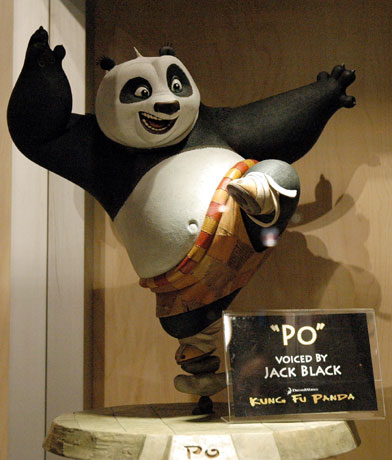
Po Panda is the main character in Kung Fu Panda movie. He is a unique big fat panda. His feather color is black and white. The black ones are in his ears, around eyes, nose, arms, and legs. The rest are white. He has very big body, because he loves eating very much. Although he has fat body, he has skill at Kung Fu. Kung Fu skill is in his blood, and it makes he become a dragon warrior. Dragon warrior is someone mastering Kung Fu and has responsibility to protect the citizen in Valley of Peace from any kind of beast.
Po Panda is a unique dragon warrior. He becomes unbeatable just because he thinks that his enemies are food, meal, or snack that he has to eat. Although he is a great dragon warrior, he is still modest. He teaches children in mastering first level of Kung Fu.
Po Panda is the main character in Kung Fu Panda movie. He is a unique big fat panda. His feather color is black and white. The black ones are in his ears, around eyes, nose, arms, and legs. The rest are white. He has very big body, because he loves eating very much. Although he has fat body, he has skill at Kung Fu. Kung Fu skill is in his blood, and it makes he become a dragon warrior. Dragon warrior is someone mastering Kung Fu and has responsibility to protect the citizen in Valley of Peace from any kind of beast.
Po Panda is a unique dragon warrior. He becomes unbeatable just because he thinks that his enemies are food, meal, or snack that he has to eat. Although he is a great dragon warrior, he is still modest. He teaches children in mastering first level of Kung Fu.
Rabu, 16 Februari 2011
Cinta Sejati di Spongebob Squarepants
Di serial Spongebob Squarepants, ada beberapa tokoh yang mencintai tokoh lain namun bukan dari spesies yang sama (dan beberapa yang sangat tak wajar). Contoh-contohnya adalah:
1. Spongebob Squarepants dengan Krabby Patty

Seperti yang kita tahu, Spongebob senang sekali bekerja di Krusty Krab. Pada salah satu serialnya, Spongebob begitu mencintai Krabby Patty hingga tidak tega memakannya.
2. Patrick Star dengan Tiang Lampu Jalan

Ini diceritakan di serial yang berjudul Krabby Kronicle, Patrick "digosipkan" menikahi tiang.
3. Sheldon Plankton dengan Karen

Karen adalah komputer Plankton yang selalu menghibur Plankton ketika mengalami kegagalan. Plankton biasa menyebutnya Karen si Istri Komputer.
4. Eugene Krab dengan Uang

Hal ini jelas tak dapat dipungkiri lagi. Haha...
5. Squidward Tentacles dengan Patricia

Patricia sebenarnya adalah Patrick yang menyamar dan bekerja di Krusty Krab. Kalian bisa menemukan Patricia di serial Spongebob yang berjudul "That's No Lady". Tidak ada seorangpun yang mengetahui penyamaran Patrick kecuali Spongebob, namun pada akhirnya penyamaran tersebut terbongkar setelah Patrick mengaku bahwa dia menyamar. Squidward yang sudah jatuh cinta dengan Patricia hanya berkata, " Sepertinya aku harus mandi." Hahaha...
6. Eugene Krab dengan Nyonya Puff

Tuan Krab memang sangat mencintai uang, namun di serial "Krusty Love", tuan Krab juga begitu mencintai Nyonya Puff. Nyonya Puff telah membuat Tuan Krab berhenti jadi pelit untuk sejenak.
Berikut adalah beberapa contoh tokoh di Serial Spongebob Squarepants yang memiliki cinta sejati. Serial Spongebob Squarepants bukan hanya menyajikan kisah-kisah komedi, tapi juga mengandung nilai-nilai moral dan kata-kata mutiara yang bila kita perhatikan sangat dalam maknanya.
Kirim di komentar jika ada tambahan, terima kasih...
~kukang~
1. Spongebob Squarepants dengan Krabby Patty
Seperti yang kita tahu, Spongebob senang sekali bekerja di Krusty Krab. Pada salah satu serialnya, Spongebob begitu mencintai Krabby Patty hingga tidak tega memakannya.
2. Patrick Star dengan Tiang Lampu Jalan

Ini diceritakan di serial yang berjudul Krabby Kronicle, Patrick "digosipkan" menikahi tiang.
3. Sheldon Plankton dengan Karen
Karen adalah komputer Plankton yang selalu menghibur Plankton ketika mengalami kegagalan. Plankton biasa menyebutnya Karen si Istri Komputer.
4. Eugene Krab dengan Uang
Hal ini jelas tak dapat dipungkiri lagi. Haha...
5. Squidward Tentacles dengan Patricia

Patricia sebenarnya adalah Patrick yang menyamar dan bekerja di Krusty Krab. Kalian bisa menemukan Patricia di serial Spongebob yang berjudul "That's No Lady". Tidak ada seorangpun yang mengetahui penyamaran Patrick kecuali Spongebob, namun pada akhirnya penyamaran tersebut terbongkar setelah Patrick mengaku bahwa dia menyamar. Squidward yang sudah jatuh cinta dengan Patricia hanya berkata, " Sepertinya aku harus mandi." Hahaha...
6. Eugene Krab dengan Nyonya Puff
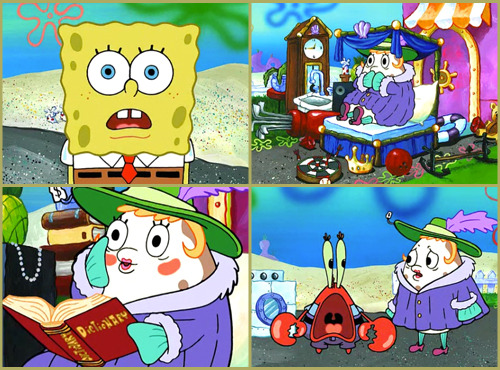
Tuan Krab memang sangat mencintai uang, namun di serial "Krusty Love", tuan Krab juga begitu mencintai Nyonya Puff. Nyonya Puff telah membuat Tuan Krab berhenti jadi pelit untuk sejenak.
Berikut adalah beberapa contoh tokoh di Serial Spongebob Squarepants yang memiliki cinta sejati. Serial Spongebob Squarepants bukan hanya menyajikan kisah-kisah komedi, tapi juga mengandung nilai-nilai moral dan kata-kata mutiara yang bila kita perhatikan sangat dalam maknanya.
Kirim di komentar jika ada tambahan, terima kasih...
~kukang~
Senin, 03 Januari 2011
MENCARI KEBENARAN TUHAN
Disela-sela jeda kuliah, saya berbincang-bincang dengan seorang teman.
Dia bertanya, “Apa sih gunanya sholat???”
Someone answer, “itu kan Cuma sebuah ritual.”
The other, “Emang udah keharusan kali???”
“Untuk mbukti’in kalo kamu yakin ma Tuhanmu.”
Ada juga yang jawab, “Gag tau!”
Hemm, what was she talking about? Saya diam sejenak, “Untuk bersyukur dan memohon sesuatu.”

Percakapan itu emang bentar dan tak ditemukan jawaban yang memuaskan. Tapi gag tahu kenapa itu kepikiran sampai sekarang. Bukan kepikiran “buat apa sholat?” tapi kepikiran “kenapa dia bisa punya pikiran apa gunanya sholat?”
Dari dulu koq aku gag pernah punya pikiran macam itu. Yang udah diperintahkan, ya jalanin aja. Hemm, mungkin itu yang buatku kadang ngrasa males njalaninnya kalo aku lagi ngrasa Tuhan gag adil ma aku (astagfirlahh…). Karena aku punya dasar, sholat untuk bersyukur. Dan sholatku jadi lebih giat (sunnah pun tariiiik!) dan tepat waktu kalo lagi memohon sesuatu. Oh my God… apa aku salah???
Dia bertanya, “Apa sih gunanya sholat???”
Someone answer, “itu kan Cuma sebuah ritual.”
The other, “Emang udah keharusan kali???”
“Untuk mbukti’in kalo kamu yakin ma Tuhanmu.”
Ada juga yang jawab, “Gag tau!”
Hemm, what was she talking about? Saya diam sejenak, “Untuk bersyukur dan memohon sesuatu.”
Percakapan itu emang bentar dan tak ditemukan jawaban yang memuaskan. Tapi gag tahu kenapa itu kepikiran sampai sekarang. Bukan kepikiran “buat apa sholat?” tapi kepikiran “kenapa dia bisa punya pikiran apa gunanya sholat?”
Dari dulu koq aku gag pernah punya pikiran macam itu. Yang udah diperintahkan, ya jalanin aja. Hemm, mungkin itu yang buatku kadang ngrasa males njalaninnya kalo aku lagi ngrasa Tuhan gag adil ma aku (astagfirlahh…). Karena aku punya dasar, sholat untuk bersyukur. Dan sholatku jadi lebih giat (sunnah pun tariiiik!) dan tepat waktu kalo lagi memohon sesuatu. Oh my God… apa aku salah???
Langganan:
Postingan (Atom)